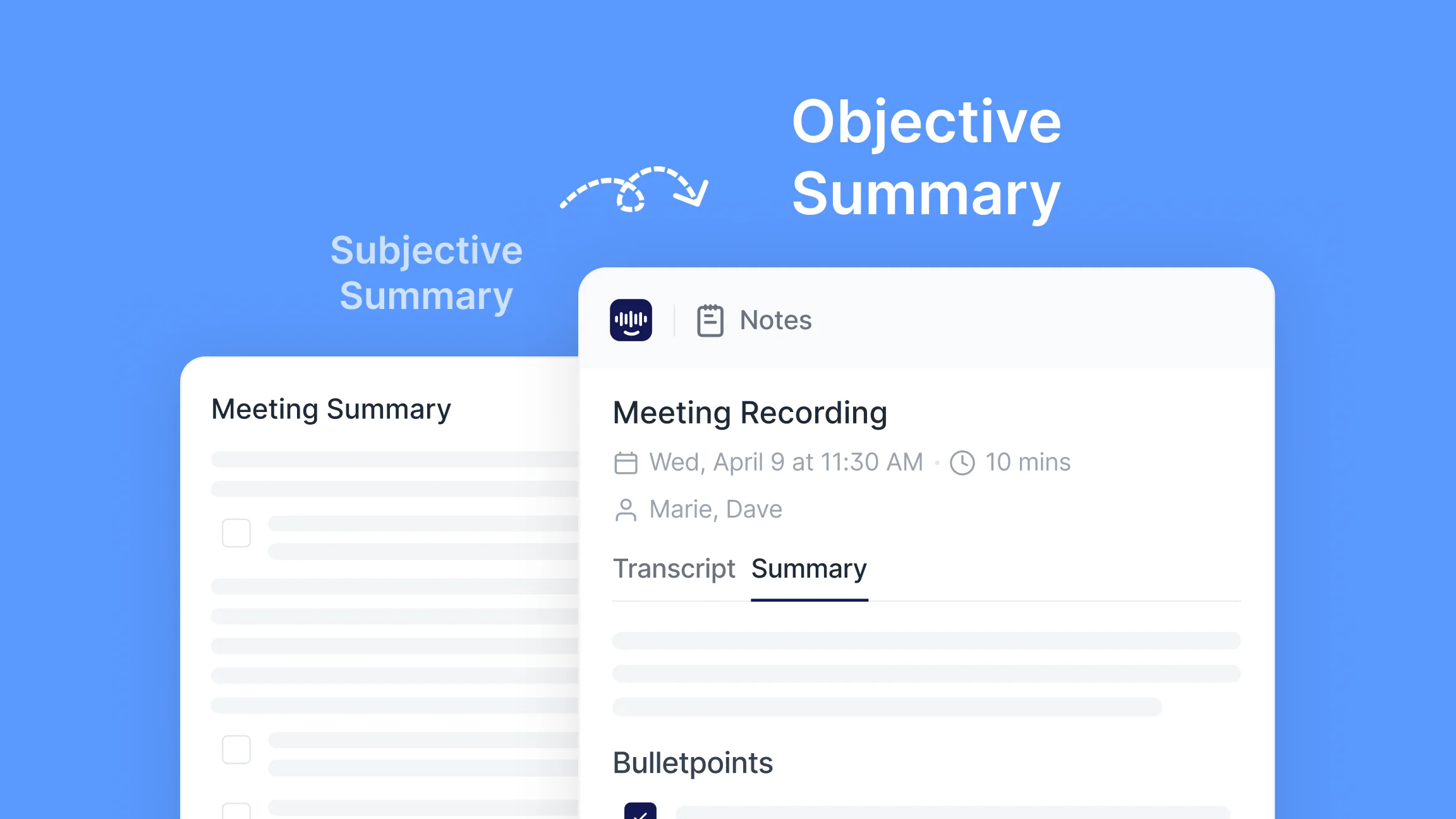
Objective Summary Definition and Meaning
The objective summary definition centers on two words: objectivity and brevity. To write an objective summary means to report what a source says, not what you think about it. The word "objective" in this context means factual and unbiased. The writer stays neutral, uses their own words, and focuses only on the information that is directly present in the source.
The objective summary meaning extends across different types of content. A summary can be written from an article, a book chapter, a research paper, a lecture, or a recorded meeting. In each case, the goal is the same: identify the central idea, select the most important supporting points, and present them accurately without adding commentary.
An objective summary is not a review, an analysis, or a personal response. It does not include phrases like "I think," "the author brilliantly argues," or "this is an important point." It also does not include information that was not in the original source. What remains is a clear, readable restatement that any reader could verify against the original.
In academic settings, objective summaries demonstrate that a student has read and understood a text. In professional settings, they give colleagues and stakeholders a fast, reliable overview of content they may not have time to read in full.
Key Characteristics of an Objective Summary
An effective objective summary shares the following qualities regardless of the source material or context it is applied to.
Neutral tone No praise, criticism, or loaded language. Words like "excellent," "problematic," or "surprisingly" introduce judgment and have no place in an objective summary.
Main idea focus The central thesis or conclusion of the source appears clearly and early. Supporting points are included only if they are essential to understanding the main idea.
Paraphrased language The writer uses their own words rather than copying phrases from the source. Direct quotes are rarely necessary and should be avoided unless the exact wording is specifically significant.
Brevity An objective summary is shorter than the source it describes. Minor details, extended examples, anecdotes, and side points that do not change the overall meaning are left out.
Accurate representation The summary reflects what the source actually says. Misrepresenting a source's position, even unintentionally, undermines the purpose of an objective summary.
What to include and what to leave out
Include:
The central idea or thesis of the source
Key supporting points, evidence, or decisions
Relevant outcomes, conclusions, or action items in the case of meetings
Leave out:
Personal opinions, interpretations, or emotional reactions
Information not present in the original source
Minor examples, extended quotes, or background details that do not affect the main point
Objective Summary Examples
Seeing how an objective summary is applied across different content types makes the concept easier to apply in practice.
Example 1: Summarizing an article
Source: A research article arguing that remote work increases productivity for independent tasks but reduces collaboration quality for creative projects.
Objective summary: "The article presents findings that remote work leads to higher individual productivity on focused tasks. However, it also reports that creative collaboration declines when teams work remotely, citing reduced spontaneous interaction as a primary factor."
Example 2: Summarizing a meeting
Source: A project status meeting where the team discussed a delayed deadline, agreed to reduce the feature scope, and assigned two action items.
Objective summary: "The team reviewed the current project timeline and confirmed that the deadline will be extended by two weeks. To manage the delay, the feature scope was reduced. Two action items were assigned: a revised schedule to be delivered by the project lead, and a client communication to be sent by the account manager."
Example 3: Summarizing a story or text
Source: A short story following a character who chooses to leave a stable job to pursue a creative career and faces significant personal and financial challenges as a result.
Objective summary: "The story follows a character who leaves a stable professional role to pursue creative work. The narrative focuses on the financial and personal difficulties that follow this decision, without indicating whether the choice was right or wrong."
Objective summary templates
For an article or report: "The [article / report] explains [main idea]. It supports this through [key point 1], [key point 2], and [key point 3]. The conclusion states [brief conclusion]."
For a meeting: "The meeting addressed [main topic]. Key decisions included [decision 1] and [decision 2]. Action items: [task], assigned to [owner], due by [deadline]."
For a story or narrative text: "The [story / text] follows [main subject or character] who [main action or situation]. Key developments include [event 1] and [event 2], leading to [outcome]."
How to Write an Objective Summary Step by Step?
Step 1: Read or listen to the full source Do not begin summarizing partway through. The main idea of a text or meeting often becomes clear only at the end, and key supporting points can appear anywhere.
Step 2: Identify the central idea State the main point in one sentence. For an article, this is usually the thesis. For a meeting, it is the primary topic or decision.
Step 3: Select two to four key supporting points Choose only the points that directly support or explain the main idea. Discard anecdotes, extended examples, and repetitions.
Step 4: Paraphrase in your own words Write the summary using your own phrasing. Do not copy sentences from the source. If a particular phrase is important, note why before deciding whether to include it.
Step 5: Review for neutrality Read the draft and remove any words or phrases that signal opinion, approval, or disapproval. Check that no information has been added that was not in the original source.
Step 6: Check length and clarity An objective summary should be significantly shorter than the source. For a short article, one paragraph is typically sufficient. For a long report or a full meeting, two to three focused paragraphs.
Common mistakes to avoid:
Adding personal analysis or interpretation to the summary
Including too many minor details that dilute the main point
Using vague language where a precise factual statement would be clearer
Misrepresenting the source's position by over-simplifying a nuanced argument
Resume Objective vs Summary: What Is the Difference?
The term "objective summary" appears in two distinct contexts. The first is the academic and professional writing definition covered above. The second is a resume context, where "objective" and "summary" refer to two different sections that serve different purposes.
A resume objective is a short statement at the top of a resume that describes what the candidate is looking for in a role. It is written from the candidate's perspective and focuses on their goals. Resume objectives are most commonly used by recent graduates, career changers, or candidates applying to a very specific type of role where stating the target position directly adds useful context.
Example of a resume objective: "Seeking a project coordinator role in a technology company where organizational and communication skills can support cross-functional team delivery."
A resume summary is a brief overview of the candidate's experience, skills, and professional background. It is written for the reader, not the candidate, and focuses on what the person brings rather than what they want. Resume summaries are more common for experienced professionals who have a track record to reference.
Example of a resume summary: "Project coordinator with five years of experience managing cross-functional initiatives in technology environments. Strong background in stakeholder communication, timeline management, and documentation."
The key difference is direction: a resume objective points toward what the candidate wants, while a resume summary points toward what the candidate offers. Most hiring managers and HR teams reviewing applications today prefer a resume summary for candidates with relevant experience, as it answers the reader's question directly rather than stating the applicant's preferences.
For candidates with no prior experience in the field, a short objective statement may be appropriate. For most other situations, a summary delivers more useful information in the same space.
How Objective Summaries Work in Professional Settings?
In workplace contexts, objective summaries appear most often as meeting notes, project status reports, and briefing documents. Their function is practical: they give readers who were not present, or who need a fast refresher, an accurate account of what was covered without requiring them to review the full source.
For teams that run frequent meetings, producing accurate objective summaries after each session is a significant documentation task. Manual note-taking during a live discussion often results in incomplete records because the note-taker cannot listen fully and write at the same time. What gets captured tends to reflect the note-taker's interpretation rather than a neutral account of what was said.
Smart Noter addresses this through automated transcription that converts meeting audio into a full, timestamped text record after each session. From that transcript, an AI generated summary identifies the main topics, key decisions, and action items in a structured format. The result is an objective account of the meeting that any participant or stakeholder can reference, rather than a subjective interpretation produced under time pressure.
For HR teams conducting interviews, performance reviews, or onboarding sessions, this is particularly useful. Interview notes written immediately after a conversation often carry recency bias or selective recall. A transcript of the session provides a neutral, complete record that supports more consistent and defensible evaluations across candidates or review cycles.
Objective summaries, whether written manually or generated from a transcript, serve the same purpose: they make spoken or written content accessible, reviewable, and usable without requiring anyone to revisit the full original source.
