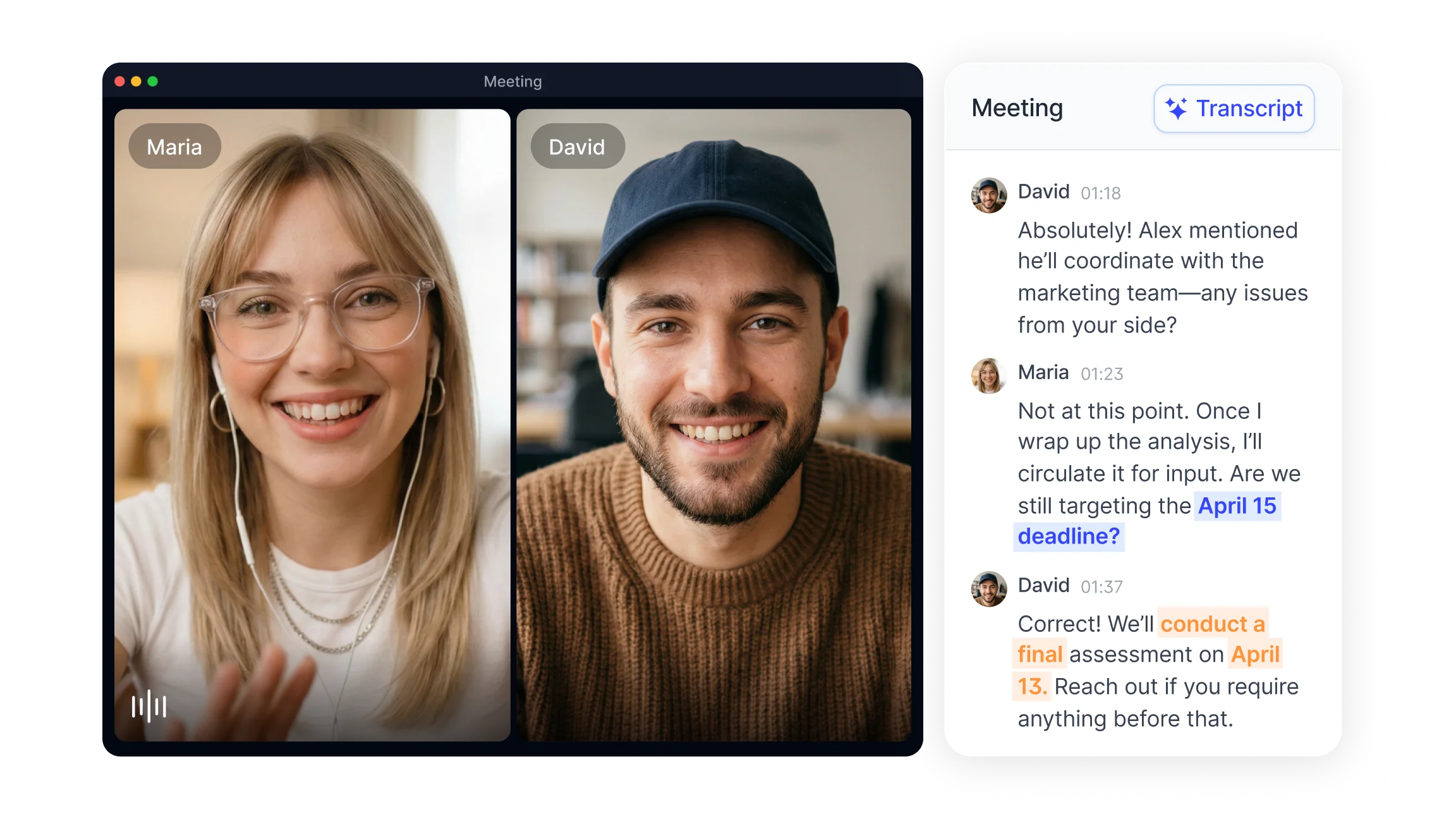
What Is an Interview Transcript?
An interview transcript is a document that captures everything said during a recorded interview in written form. It preserves the spoken content, identifies who said what, and marks when each statement occurred. Transcripts are used across research, journalism, HR, legal, and content production contexts wherever an accurate and searchable written record of a spoken conversation is required.
Interview transcripts differ from meeting notes or summaries. A transcript is a complete record of the conversation as it happened. A summary extracts and condenses the key points. Both serve different purposes: a transcript is the source of truth, and a summary is the working document derived from it.
The term "transcript from interview" and "interview transcripts" refer to the same artifact: the full written text produced from a recorded interview session, organized by speaker and time.
How to Transcribe an Interview Step by Step
The steps below apply to AI-assisted transcription, which is the standard method for most professional interview workflows in 2026.
Step 1: Record the interview in a clean audio environment
The quality of the transcript depends directly on the quality of the recording. Record in a quiet space, use a dedicated microphone where possible, and ensure all speakers are at a consistent volume. For remote interviews conducted via Zoom or Google Meet, use the platform's built-in recording feature or connect Smart noter to capture the session automatically.
Step 2: Export or upload the audio or video file
Export the recording in a widely supported format. MP3 and MP4 are accepted by most AI transcription tools. WAV produces higher quality but larger files. If the interview was recorded directly within a transcription tool, this step is handled automatically.
Step 3: Upload to an AI transcription tool and set the language
Upload the file or paste the recording link. Set the primary language of the interview so the AI applies the correct language model. Smart noter's audio to text feature supports +98 languages, making it suitable for multilingual and cross-border interview workflows.
Step 4: Select the transcription style
Choose between verbatim, clean verbatim, or summary transcription before or after processing depending on the tool. For HR interviews and research, clean verbatim is the most common choice. For legal and compliance contexts, full verbatim is typically required.
Step 5: Review speaker labels and rename them
AI transcription tools detect voice changes and assign labels such as Speaker 1 and Speaker 2. After the transcript is generated, rename these labels to the actual names or roles of the participants: Interviewer, Candidate, Respondent, or specific names where appropriate.
Step 6: Review and edit for accuracy
Read through the transcript while comparing against the recording. Focus on proper nouns, technical terms, and any sections with background noise or overlapping speech, as these are the most likely sources of errors. Correct speaker attribution wherever the AI has misidentified a voice change.
Step 7: Add formatting and export
Apply consistent formatting: bold or uppercase speaker labels, paragraph breaks between speaker turns, timestamps at regular intervals or at each speaker change. Export the completed transcript in the format required for its intended use: DOCX for editing, PDF for sharing, or plain text for analysis tools.
Interview Transcript Format: What to Include?
A consistent format makes interview transcripts easier to read, analyze, and share. The standard format for a professional interview transcript includes the following elements.
Header information
The document should open with the interview date, time, location or platform, names and roles of all participants, and the name of the interviewer. For research transcripts, also include the project name or study reference number.
Speaker labels
Each speaker turn begins with a clearly formatted label. Common conventions include the speaker's name in bold followed by a colon, or the role label in uppercase. The label appears at the start of each new speaker turn regardless of length.
Timestamps
Timestamps appear at the start of each speaker turn or at regular intervals such as every thirty seconds or every minute. The most common format is MM:SS for shorter interviews and HH:MM:SS for sessions over one hour.
Speaker turns and paragraphs
Each speaker turn is a separate paragraph. Long turns covering multiple topics can be broken into shorter paragraphs for readability. A blank line between speaker turns improves visual clarity.
Footer or end notation
The transcript ends with a notation indicating it is complete: "End of transcript" or "End of recording." For research transcripts, include the total duration and the name of the person who produced or reviewed the transcript.
Interview Transcript Examples
The following examples show how the same content looks in different transcript styles and formats. These are practical reference examples that can be adapted to most interview contexts.
Example 1: Job interview transcript (clean verbatim)
Interview Date: June 10, 2026 Participants: Sarah Malik (Interviewer), James Chen (Candidate) Position: Senior Product Manager
[00:00] Sarah Malik: Thanks for joining us today, James. Can you walk me through your experience with cross-functional product launches?
[00:08] James Chen: Absolutely. In my previous role, I led the launch of three enterprise products over two years. Each involved coordinating between engineering, marketing, and customer success from ideation through to release.
[00:22] Sarah Malik: How did you handle situations where the engineering timeline didn't align with the marketing deadline?
[00:29] James Chen: I would schedule a realignment meeting early rather than waiting for the conflict to escalate. We would identify the minimum viable scope that could ship on time and negotiate the rest into a follow-up release.
Example 2: Research interview transcript (verbatim)
Interview Date: May 28, 2026 Project: Remote Work Productivity Study Participants: Interviewer (I), Respondent 04 (R04)
[00:00] I: So, um, can you describe a typical workday for you since switching to fully remote?
[00:06] R04: Yeah, so, uh, it's kind of, it really depends on the week. Like, most days I start around eight, but sometimes, you know, if I have a late call the night before, I'll push it to nine.
[00:19] I: And how do you structure your focus time?
[00:22] R04: I block out mornings for deep work, so no meetings before eleven. That was, that was a rule I set for myself after the first month because otherwise I just, I couldn't get anything done.
Example 3: Journalistic interview transcript format
Interview: July 2, 2026 Subject: Dr. Aisha Patel, Director of Climate Research Institute Interviewer: Marcus Lee
[00:00] Lee: Dr. Patel, your recent study challenges the existing models for sea level projections. What was the key finding?
[00:08] Patel: The key finding is that current models systematically underestimate the contribution of ice sheet dynamics in the Southern Ocean. Our data suggests projections for 2100 need to be revised upward by approximately fifteen percent.
[00:24] Lee: How should policymakers respond to this?
[00:27] Patel: They need to incorporate this uncertainty into coastal infrastructure planning immediately. The margin for error in current policy timelines is much smaller than assumed.
These examples show the core structure of an interview transcript: header information, speaker labels, timestamps, and formatted speaker turns. The verbatim example includes filler words and natural speech patterns; the clean verbatim examples remove them for readability.
Verbatim vs Clean Verbatim vs Summary: Which Style to Use?
The transcription style determines how the spoken content is represented in the written document. Each style serves a different purpose and suits different contexts.
Verbatim transcription captures every word spoken, including filler words such as "um," "uh," and "you know," false starts, repetitions, laughter, and pauses. This style is required when the exact speech pattern is analytically relevant, as in linguistic research, legal proceedings, or qualitative studies where how something was said matters as much as what was said.
Clean verbatim transcription removes filler words, corrects obvious speech errors, and smooths repetitions while preserving the full content and meaning of what was said. This is the standard format for HR interviews, journalistic interviews, podcast transcripts, and most professional documentation contexts. It is easier to read than verbatim and sufficient for almost all non-legal, non-linguistic use cases.
Summary transcription condenses the interview into the key points, themes, and decisions without preserving the full dialogue. This format is used when the goal is a brief reference document rather than a complete record. It is not suitable as a primary record but works well as a companion to a full transcript when a quick review document is needed.
For HR teams conducting hiring interviews, clean verbatim is the most practical choice. It provides a complete record of what each candidate said without the cognitive overhead of processing every filler word. A summary transcript can then be generated from the full clean verbatim document for review by hiring managers who did not attend the interview.
How AI Interview Transcription Works in 2026?
AI interview transcription uses automatic speech recognition models combined with speaker diarization and natural language processing to convert recorded interviews into formatted text documents.
The process runs in four stages:
Speech detection segments the audio into speech and non-speech portions and identifies where each speaker begins and ends.
Speaker diarization analyzes voice characteristics to separate different speakers and assign labels to each voice throughout the recording. This is the technology behind automatic speaker labeling in multi-person interview transcripts.
Speech to text conversion maps the acoustic signals to words using language models that account for context, accent, and conversational patterns. This produces the raw transcript text.
Post-processing applies punctuation, capitalization, and paragraph formatting to produce a readable document. In AI tools that include summary features, a second processing pass extracts the key points and structures them into a meeting summary format.
Smart noter applies this full pipeline to interview recordings uploaded as audio or video files. The output includes a timestamped, speaker-labeled transcript at up to 99% accuracy for clear recordings across +98 languages. The summary generated alongside the transcript identifies the main topics, notable statements, and any action items or follow-up questions that emerged during the interview.
For HR teams managing high-volume hiring processes, this workflow eliminates the manual transcription step entirely. Each recorded interview is processed automatically, producing a structured document that all hiring stakeholders can access and search without replaying the recording.
Who Uses Interview Transcription?
Interview transcription is used across a wide range of professional and research contexts. The use case determines which format and level of detail is appropriate.
Human resources and recruiting
HR teams transcribe job interviews to create a consistent written record of each candidate's responses. This supports fair evaluation across multiple interviewers, provides documentation for compliance purposes, and allows hiring managers who were not present to review what was discussed. AI transcription reduces the time between interview completion and documented review.
Qualitative researchers
Researchers in social sciences, education, healthcare, and behavioral studies transcribe recorded interviews with study participants. The transcript becomes the primary data source for coding, thematic analysis, and direct quotation in academic publications. Verbatim style is typically required for research to preserve the integrity of the spoken data.
Journalists and documentary makers
Journalists transcribe recorded interviews to produce accurate quotes for articles and to build a searchable archive of source material. Documentarians transcribe interview footage to identify usable segments for editing and to create captions and subtitles.
Legal and compliance professionals
Legal teams transcribe depositions, witness interviews, and investigative recordings to create admissible written records. Verbatim transcription is standard in this context because exact phrasing can be legally significant.
Podcast producers and content creators
Podcast producers transcribe episodes to publish show notes, create searchable archives, and repurpose spoken content into written articles or social media posts. Audio to text conversion is the core step in this workflow.
Sales and customer success teams
Sales teams transcribe recorded customer calls and discovery interviews to extract objections, buying signals, and competitor mentions. This feeds coaching, onboarding, and strategy processes. The transcript becomes a searchable record of every customer conversation.
