Is It Illegal to Record Someone Without Their Permission?
The legality of recording without consent is determined by a combination of federal law, state or regional wiretapping statutes, and the specific context of the recording. In the United States, the federal Electronic Communications Privacy Act sets a baseline standard, but individual states can and do impose stricter requirements.
The core legal concept governing most recording situations is whether the person being recorded has a reasonable expectation of privacy. A conversation held quietly between two people in a private office carries a different legal weight than a discussion held loudly in a public park. The location, the nature of the conversation, and whether the recorder is a participant all affect the analysis.
Recording a private conversation that you are not a part of is illegal in virtually every jurisdiction in the United States. Placing a hidden recording device in a room to capture others' conversations without participating in them constitutes eavesdropping and is treated as a felony under federal law and most state statutes.
One-Party vs All-Party Consent: What Is the Difference?
The most important distinction in U.S. recording law is between one-party consent and all-party consent, sometimes called two-party consent.
One-party consent
Under federal law and the laws of approximately 36 states including New York, Texas, and Ohio, only one participant in a conversation needs to consent to a recording. Because the person doing the recording is a participant in the conversation, their own consent is legally sufficient. This means a participant can lawfully record a phone call, meeting, or in-person conversation without informing the other parties, as long as the recorder is actively part of that conversation.
All-party consent
In 11 states, all participants in a conversation must consent before any recording takes place. Secretly recording a conversation in these states is a criminal offense regardless of whether the recorder is a participant. The all-party consent states include:
California
Florida
Illinois
Maryland
Massachusetts
Montana
Nevada
New Hampshire
Oregon
Pennsylvania
Washington
If you are unsure which rule applies in your situation, following the all-party consent standard is the safer default. Obtaining consent from all participants protects against liability in any jurisdiction.
Cross-state and international calls
When participants are located in different states or countries, the stricter law applies. If you are in a one-party consent state and call someone in California, which requires all-party consent, California's law governs the recording. Cross-border calls introduce the highest compliance risk because the recorder may not know where the other party is located. The standard practice for businesses handling calls across jurisdictions is to provide verbal notice at the start of every call regardless of the caller's location.
Recording in Public Spaces: What Is Legal?
The rules change significantly when recording takes place in a public space. In general, individuals in public areas where they are visible and audible to others do not have a reasonable expectation of privacy.
What is generally permitted in public
Recording video and audio of people in public parks, sidewalks, streets, and open public venues is generally lawful in the United States without the subjects' consent. If someone is in a location where any passerby could see or hear them, they cannot legally claim an expectation of privacy over what is visible and audible from that public vantage point.
This principle is sometimes called the naked eye rule: if a person or location can be freely observed from a public position, recording it falls within First Amendment protections.
What is not permitted in public
Public spaces are not uniformly open to recording. Areas where privacy is explicitly guaranteed remain protected even when they are technically accessible to the public. Recording in public restrooms, changing rooms, locker rooms, or similar spaces where individuals reasonably expect privacy from observation is illegal regardless of whether the location is technically public.
Additionally, some states impose restrictions on audio recording in public even when video recording is permitted. Recording the audio of a private conversation happening in a public space, where the speakers have taken steps to keep the conversation private, may still require consent depending on the jurisdiction.
Recording on Private Property and in the Workplace
Private property
Private property owners have the right to prohibit photography and recording on their premises. Retail stores, office buildings, shopping centers, and other privately owned spaces can legally require visitors to stop recording, and can have individuals removed or arrested for trespassing if they refuse to comply.
In residential settings, homeowners can generally install security cameras to monitor their own property. However, in all-party consent states, audio recording of guests inside the home without their knowledge may violate wiretapping statutes even on your own property. Security systems that capture audio rather than video only require additional consideration in these jurisdictions.
Workplace recording
The workplace presents one of the most complex environments for recording consent questions. Employees frequently ask whether they can record meetings with managers, HR conversations, or disciplinary proceedings.
The answer depends on three overlapping factors: the consent law of the state where the recording takes place, the employer's internal recording policy, and whether the recorder is a participant in the conversation.
In one-party consent states, an employee who is a participant in a meeting may legally record it without informing the employer, unless company policy explicitly prohibits it. In all-party consent states, recording a meeting without the knowledge and consent of all participants is illegal regardless of the employee's purpose.
Many employers operate with written policies that prohibit recording in the workplace without prior authorization, even in one-party consent states. These policies are generally enforceable as a condition of employment. Violating a workplace recording policy can result in disciplinary action or termination even when the recording itself would not be criminally prosecuted.
For HR teams managing interviews, performance reviews, and sensitive employee conversations, having a documented recording policy and obtaining explicit consent before capturing any session is the most defensible approach regardless of the jurisdiction's baseline rule.
What Happens If You Record Someone Illegally?
Violating recording consent laws carries both criminal and civil consequences.
Criminal penalties
Illegal recording under federal wiretapping law can result in felony charges. Penalties include fines and imprisonment of up to five years per offense. State wiretapping statutes impose their own penalties, which vary in severity but frequently include felony classification for intentional violations. Recording a private conversation you are not part of, which constitutes eavesdropping rather than participant recording, carries the most serious criminal exposure.
Civil liability
In addition to criminal prosecution, the person who was recorded without consent can bring a civil lawsuit for damages. Courts can award actual damages, statutory damages in states that provide for them, and in some cases punitive damages if the violation was intentional and egregious.
Inadmissibility of the recording
Illegally obtained recordings are generally inadmissible as evidence in court proceedings. This means that a recording made in violation of consent laws cannot be used to prove the very thing the recorder was trying to document. The recording exists but carries no legal weight and may instead be used as evidence of the recorder's own misconduct.
Reputational and professional consequences
Beyond legal penalties, unauthorized recording in professional contexts creates significant reputational risk. Employees, clients, or partners who discover they were recorded without consent typically lose trust in the organization involved. In regulated industries, unauthorized recordings may trigger compliance reviews and regulatory scrutiny beyond the immediate legal liability.
Best Practices for Businesses Recording Meetings
Organizations that regularly record meetings, calls, or interviews should operate with a consistent consent-first approach that protects both the business and the people being recorded.
Provide verbal notice at the start of every recorded session A brief statement at the opening of a call or meeting that informs all participants the session is being recorded is the most direct form of consent documentation. This applies regardless of the jurisdiction's baseline consent requirement because it removes ambiguity entirely.
Include recording notice in calendar invitations and meeting agendas Written notice before the session ensures participants know in advance that recording will occur. This gives them the opportunity to raise concerns before joining rather than during the meeting itself.
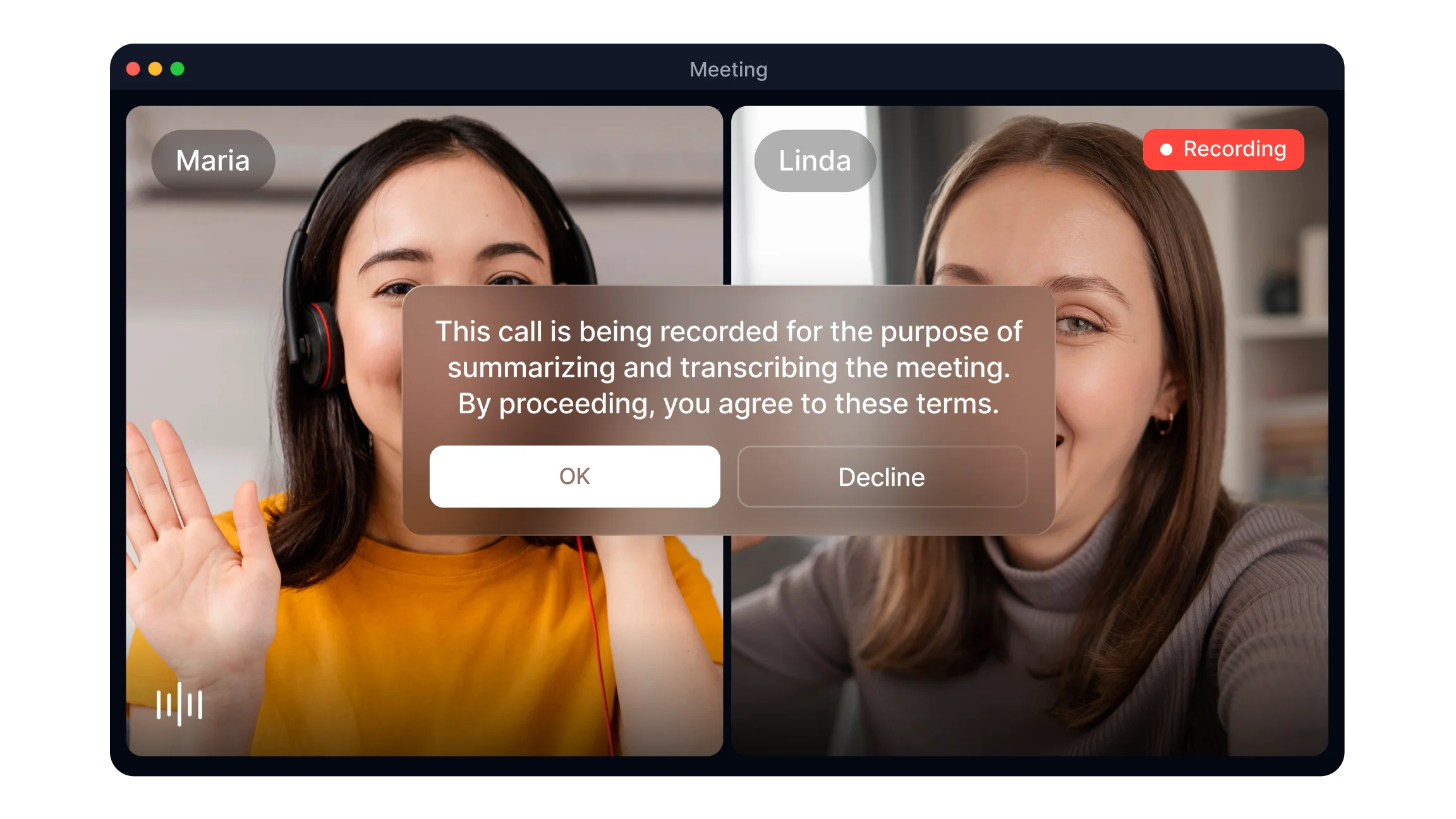
Use platform recording indicators Most online meeting platforms including Zoom and Google Meet display a visible indicator when recording is active. These automatic notifications serve as a form of technical notice to all participants and are a baseline expectation for professional meeting recording practice.
Store recordings and transcripts securely Recorded content should be stored with controlled access and a defined retention period. Access to recordings and their derived transcripts should be limited to those with a legitimate need. Recordings that are no longer needed should be deleted according to the organization's data retention policy.
Document a written internal recording policy A formal policy that outlines when recording is permitted, who must consent, how recordings are stored, and what constitutes a violation gives employees clear guidance and reduces the risk of unauthorized recordings being made by well-intentioned staff who simply did not know the rules.
Train relevant teams on consent requirements Legal requirements differ by state and change over time. Teams that regularly conduct recorded calls, particularly those operating across state lines or internationally, should receive periodic training on current consent standards for the jurisdictions they operate in.
Smart Noter supports a consent-first recording workflow by providing visible recording indicators, producing accurate transcripts and structured meeting summaries from captured sessions, and integrating with Zoom, Google Calendar, and Outlook so that documentation is consistent and complete across all recorded meetings.
