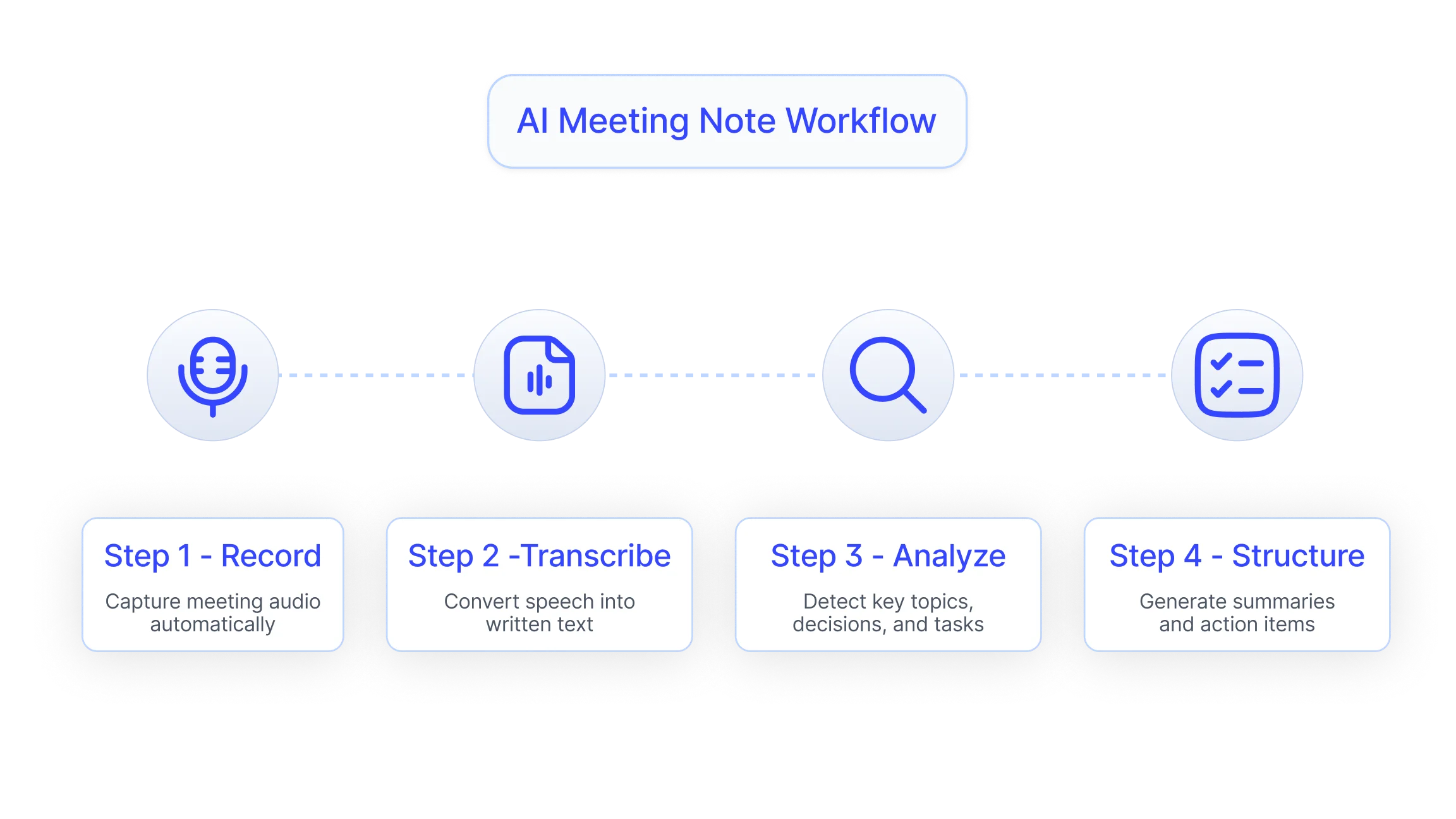
Structured output is what makes AI generated notes useful in real workflows because the content is ready to act on rather than a long, unstructured transcript.
What Structured Meeting Notes Actually Contain?
Structured meeting notes are more than raw transcripts; they present information in ways that support action and review.
Executive Summary
A short overview of what the meeting covered, including main objectives and outcomes for a quick snapshot of purpose and conclusions.
Key Decisions
Clear statements of important conclusions reached during the meeting, listed so decisions are easy to find and reference.
Action Items
Tasks detected in speech and converted into a checklist with assigned owners and, where available, deadlines to support follow up and accountability.
Speaker Identification
Labels showing who contributed each point or decision, helping link responsibilities to participants and preserving context.
Key Topics
Organized themes or subjects discussed, often with short notes under each topic to explain what was said and why it mattered.
These components form ai structured meeting notes and make it faster for teams to review and act on meeting outcomes.
Why Structured Meeting Notes Improve Team Productivity?
Structured notes reduce confusion and make follow up simpler, producing practical workflow improvements.
Clearer accountability: Assigning tasks in the notes creates an auditable trail of responsibility.
Faster decision tracking: Key decisions are summarized and easy to retrieve, speeding up subsequent work.
Easier onboarding: Absent team members can read concise summaries to catch up quickly.
Improved project continuity: Searchable meeting histories preserve context across project stages.
These gains show how ai meeting documentation tools save time and improve consistency in team operations across different departments.
Real Examples of How AI Turns Conversations into Action
Modern AI tools do more than summarize meetings; they generate actionable outputs teams can use immediately.
Extracting Action Items
Spoken commitments like "I'll handle the vendor follow up by Friday" are detected, converted into tasks, and attached to the named person with a suggested deadline.
Creating Follow-Up Messages
Meeting outcomes are turned into concise, ready to send summaries for participants and stakeholders, saving time on manual write ups.
Generating Reports and Documents
Long discussions on strategy or requirements can be converted into structured reports through a meeting summarizer that groups findings, decisions, and next steps for broader distribution.
Capturing Key Moments from Conversations
Important segments, such as approvals, estimates, or client feedback, are highlighted and timestamped so they can be reviewed later.
Tracking Ongoing Responsibilities
Recurring meetings benefit from persistent documentation where past action items and ongoing responsibilities are tracked across sessions, which is especially useful for HR teams managing recurring check-ins.
These examples illustrate how ai conversation to notes workflows move meetings from talk to traceable work.
Benefits of Using AI to Structure Meeting Conversations
AI generated structured notes reduce manual effort and make records more consistent.
Faster documentation: Transcripts and summaries shorten the time spent writing notes.
Improved collaboration: Shared structured notes create a single reference point for the team.
Searchable meeting history: Transcripts and tagged topics make past conversations easy to find.
Better knowledge retention: Organized documentation preserves institutional memory.
Reduced manual workload: Less time spent on note taking frees time for higher value tasks.
These benefits reflect realistic productivity improvements from using an ai meeting note taker system.
Limitations and Considerations When Using AI Meeting Notes
AI note taking tools are effective but have limitations that should be considered.
Transcription accuracy depends on audio quality; background noise or poor microphones can reduce clarity.
Accents, specialized vocabulary, or overlapping speech may affect recognition and require correction.
Privacy and data handling must be addressed through clear policies and secure settings.
Human review may still be necessary for legal records, approvals, or nuance sensitive content.
Understanding these factors sets realistic expectations for how ai meeting notes work in practice.
The Role of AI Meeting Tools in Modern Workflows
Meetings generate large amounts of verbal information that require documentation to maintain accountability and continuity. Structured summaries and searchable transcripts make it easier to track decisions, follow up on tasks, and onboard team members. Platforms built for converting speech into structured documentation capture conversations, extract key points, and store decisions in a searchable archive. Beyond static notes, teams can also revisit meeting content through AI chat, asking follow up questions directly against the transcript. Smart Noter is an example of a system that converts speech into structured meeting records, generates summaries and action lists, and organizes ai meeting documentation so teams can move from conversation to actionable follow up efficiently.