Why Welcome Messages Matter More Than You Think?
The first message a new employee receives sets an expectation about how the team communicates, whether support is available, and how much their arrival was anticipated. A generic greeting signals a generic experience. A specific, thoughtful one signals that someone prepared.
Research from Gallup indicates that employees who experience a strong onboarding process are significantly more likely to report high engagement and plan to stay with their organization long term. Welcome messages are a small but early part of that experience. They are often the first direct communication a new hire receives from their manager or colleagues, arriving before the first meeting, before any task, and before any real relationship has formed.
For HR teams managing onboarding across departments or locations, the quality and consistency of these messages also reflects how the organization treats new members at scale. A well-crafted welcome reduces first-day anxiety, signals psychological safety, and gives the new hire something concrete to reference as they begin.
10 Ways to Say Welcome to the Team
The examples below are organized by tone and context. Each one can be adapted for email, a team chat message, or a verbal greeting in a kickoff meeting.
Professional and role focused
These work well in formal environments or when the new hire comes from a senior or specialized background.
"Welcome to the team. Your experience in [area] is exactly what this group has been looking for, and we are glad to have you here."
"We are pleased to have you onboard. The work ahead is meaningful and your perspective will contribute directly to it."
"Welcome. We have a lot of interesting challenges coming up and your skills are going to be a strong addition to how we approach them."
Warm and encouraging
These suit teams that operate with an open, collaborative culture and want the new hire to feel at ease quickly.
"So glad you are here. Starting somewhere new takes courage and we want you to know this team has your back from day one."
"Welcome to the group. There are no silly questions here and we mean that. Ask anything, any time."
"Happy you joined us. We work hard but we also take care of each other, and you are going to fit right in."
Support and mentorship focused
These are especially effective from managers or senior team members who want to signal availability and guidance.
"Welcome to the team. As you get settled in, please reach out with anything you need. Getting up to speed takes time and we are here to make that easier."
"Glad to have you onboard. I have set aside time this week for a proper introduction so we can talk through the role, the team, and what success looks like here."
"Welcome. The first few weeks involve a lot of new information. Let me know what is unclear and we will work through it together."
Action oriented and forward looking
These work well when a team has an active project in motion and wants to integrate the new hire quickly.
"Welcome to the team. We have a project kicking off shortly and your input from the start will make a real difference. Let's get you into the loop this week."
What Makes a Welcome Message Actually Work?
Not all welcome messages land equally. The ones that leave an impression share a few specific qualities.
Specificity over generality
Mentioning the person's name, their role, or a specific skill they bring makes the message feel directed rather than template-generated. "We are glad to have a data analyst with your background on the team" lands differently than "welcome aboard."
A clear next step
A welcome message that includes a concrete action reduces the uncertainty of the first day. Suggesting a kickoff call, pointing to a Slack channel, or naming a person to reach out to gives the new hire something to do rather than just something to read.
An offer of support
New hires consistently report that knowing support is available reduces first-day anxiety more than any amount of process documentation. A simple "reach out with anything" paired with a named person or time slot makes the offer feel real.
Appropriate tone for the context
A message sent via a formal email introduction should read differently from a quick chat message in a team channel. Matching tone to medium shows awareness of context and makes the greeting feel intentional rather than copied from a template.
Timeliness
A welcome message sent before the first day or within the first hour of day one carries more weight than one that arrives after the new hire has already spent half a day navigating new systems alone. Early is better.
How to Welcome Remote and Hybrid Team Members?
Remote and hybrid onboarding presents a specific challenge: the informal moments that naturally create connection in a shared office do not happen on their own. A new hire joining remotely does not overhear conversations, bump into colleagues in the kitchen, or pick up on team culture through proximity. Welcome messages and structured introductions carry more weight in these settings because they are often the only planned touchpoints in the first few days.
For remote team members, an effective welcome sequence typically includes:
A personal message from the manager before day one, confirming schedule, access, and who to contact with questions
A team channel introduction from a colleague or HR contact that names the new hire and gives brief context on their role
A scheduled video call in the first two days specifically for introductions rather than task handoff
A recorded onboarding session or shared notes from previous meetings that the new hire can review at their own pace
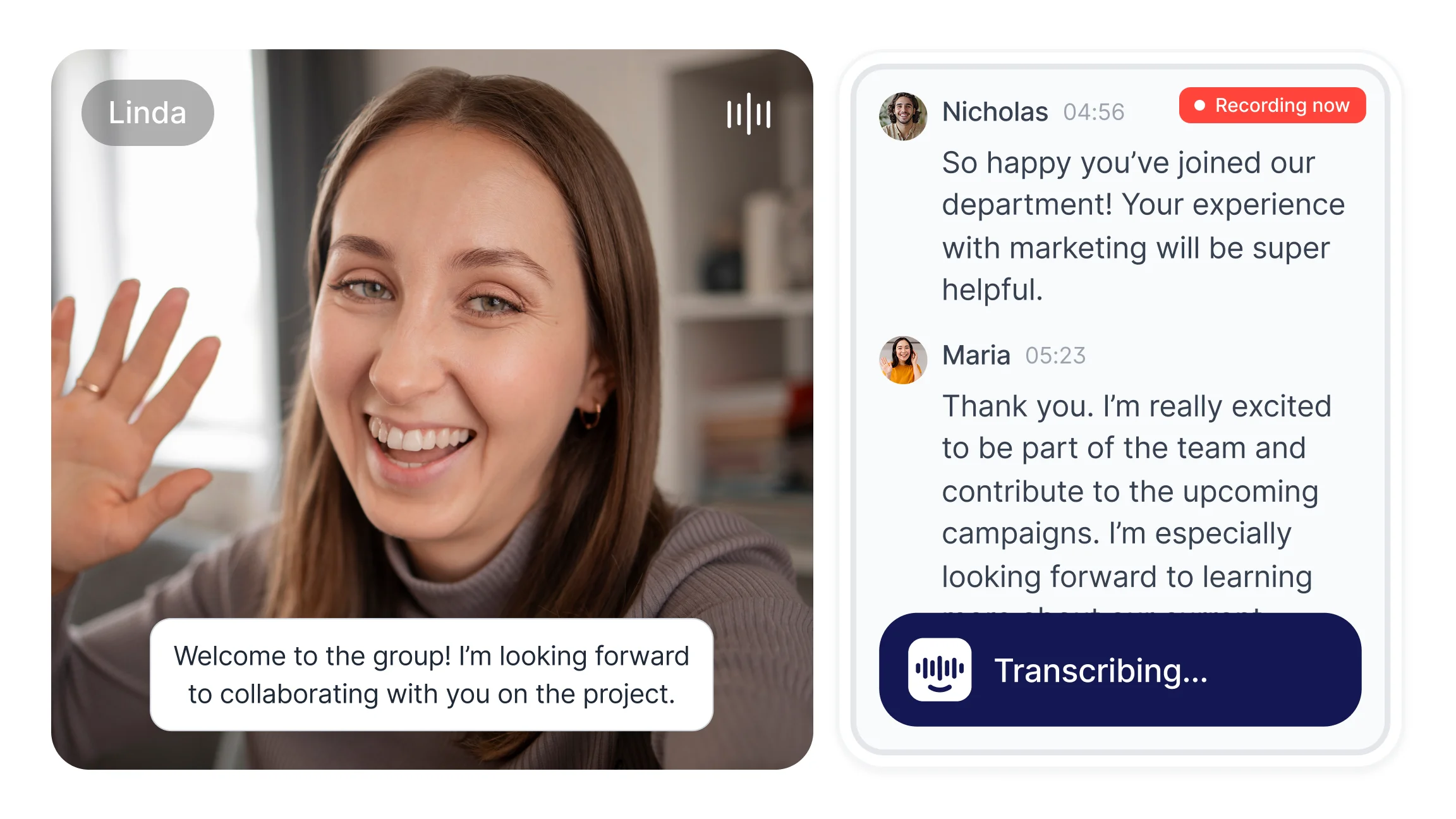
That last point matters for distributed teams operating across time zones. When onboarding conversations are recorded and summarized, new hires can revisit what was said, catch context they missed, and access information without needing to schedule a follow-up call. Smart Noter's meeting summarizer captures onboarding sessions automatically, producing a structured summary and transcript that the new hire can reference throughout their first weeks.
For HR teams managing onboarding at scale, this also reduces the burden of repeating the same orientation information across multiple sessions. A well-documented first session becomes a reusable asset rather than a one-time conversation.
How Smart Noter Supports Onboarding Conversations?
Onboarding involves more spoken information than almost any other business process. Role expectations, team norms, project context, tool access, communication preferences, and organizational structure are all introduced in a short window, usually across several meetings in the first week.
Most new hires cannot absorb and retain all of it in real time. And most teams do not have a reliable system for capturing what was covered so that new hires can revisit it later. The result is repeated questions, slower ramp-up, and gaps in understanding that take weeks to surface.
Smart Noter addresses this by recording and transcribing onboarding meetings automatically. Each session produces a full transcript with speaker labels, a structured summary of key points, and a list of action items extracted from the discussion. New hires can search the transcript for specific information rather than asking the same question twice. Managers can verify that critical context was actually communicated rather than assuming it was retained.
For teams using Zoom, Google Calendar, or Outlook, Smart Noter integrates directly so that onboarding sessions are captured without any additional setup. The documentation is available immediately after the session ends and can be shared with the new hire, their manager, or the broader HR team.
Welcome messages start the relationship. Structured onboarding conversations build it. And accurate, accessible documentation of those conversations ensures that what was said on day one is still available and actionable on day thirty.
