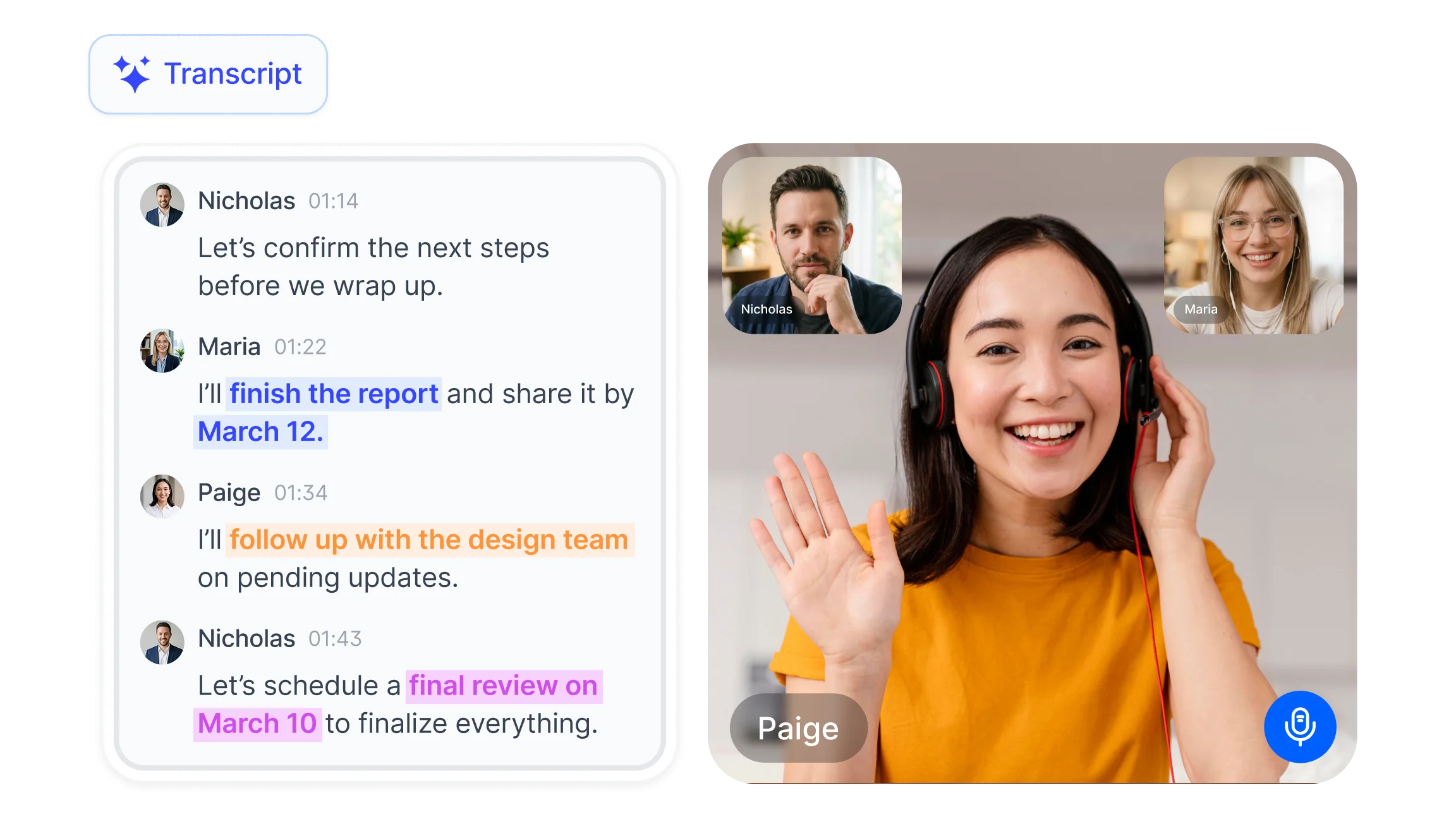
How AI Action Points Work In Modern Meeting Workflows?
Modern meetings often produce long notes without clear next steps. AI action points change that by extracting discrete tasks from transcripts and linking them to owners, timelines, and reminders. The workflow begins when a participant chooses to record or upload meeting audio. The audio is converted from voice to text with speech to text and voice to text processes. Natural language processing then analyzes the transcript to find phrases that signal decisions, commitments, or requests, for example, "Can Alex take the draft?" or "We need this by Friday."
When a task like phrase is found, the system creates a structured task description, detects any mentioned deadlines or timelines, and assigns an owner when a participant is clearly responsible. Tasks are added to a meeting action list and can be scheduled for follow up reminders or synced with task management tools. This process turns loose meeting dialogue into structured meeting action points that are easy to review and track.
Core components of AI action points include:
Task description generated from conversation
Assigned owner or responsible person
Mentioned deadline or timeline
Follow-up reminders and tracking
Integration with workflow or task management tools
The full workflow depends on reliable transcription and contextual understanding: record or import audio, transcribe speech to text, detect task-indicating phrases, create action items with metadata, and surface those items in meeting summaries or task dashboards. The result is a consistent way to capture ai generated action items and maintain accountability across meetings.
Key Features Of AI Tools That Generate Meeting Action Points
AI meeting assistants include features that support accurate action point creation and ongoing task tracking. These capabilities help teams keep follow-through consistent and make meeting results usable in daily work.
Common capabilities include:
AI-driven meeting transcription and recording: Converts spoken content into searchable text.
Smart detection of tasks and decisions: Identifies language that implies responsibility or commitments.
AI-generated summaries and meeting highlights: Presents concise overviews with extracted action items.
Task assignment and ownership tracking: Attaches owners and participant names to action items.
Deadline detection and reminder scheduling: Detects dates or timeframes and sets reminders.
Integration with productivity and collaboration tools: Exports tasks to calendars, task boards, or messaging apps.
Searchable meeting history and action tracking: Keeps an archive of ai meeting notes with action items for review across meetings.
These features work together to provide ai meeting task tracking and ai meeting follow ups that are visible and traceable. A dependable transcript and contextual intent detection are central to turning spoken suggestions into practical follow up tasks.
Real World Examples Of AI Action Points In Different Types Of Meetings
Project planning meeting: During a sprint planning session, the AI detects "Sam will update the roadmap by next Wednesday" and creates an action item: "Update project roadmap, assigned to Sam, due next Wednesday." The task is stored and a reminder scheduled.
Client discussion: On a client call where a revised proposal is requested by month end, the AI extracts: "Prepare revised proposal, assigned to Client Lead, due month end." The task joins the client follow-up list.
Internal team sync: In daily stand-ups, short commitments like "I'll finish the test cases today" are converted into same day tasks with reminders, helping surface blockers quickly.
Leadership review: Decisions in executive meetings, such as approving a budget or assigning a sponsor, are recorded as formal action items with owners and timelines, preserving accountability for long-term initiatives.
These examples show how ai action items from meetings make outcomes clearer and reduce the chance that spoken commitments are forgotten.
Common Challenges When Managing Meeting Action Points
Manual handling of action items often leads to ambiguity and lost work. Common problems include unclear ownership, inconsistent tracking, missed deadlines, and scattered notes across platforms. Without clear extraction, meeting notes remain reference material rather than drivers of action.
AI reduces these risks by structuring action points and making them searchable. Remaining challenges include accurate speaker identification, interpreting implied tasks, and ensuring assignments reflect the correct participant when language is vague. Proper setup, periodic review, and human validation help keep task quality high and reduce false assignments.
When Should Teams Use AI Action Points In Meetings?
AI-generated action points offer the most value in situations that require consistent follow-up and cross-team coordination. Typical scenarios include:
Recurring meetings where tasks carry over from session to session.
Fast-moving projects with multiple parallel tasks and frequent handoffs.
Cross-functional collaboration where responsibilities must be clearly tracked.
Client-facing calls that require documented deliverables and deadlines.
Smart Noter fits naturally into these workflows as a structured AI meeting solution. Smart Noter records audio or joins meeting links to transcribe discussions, detects responsibilities and deadlines, and organizes ai generated action items into searchable meeting summaries and task lists. For daily stand ups, sprint planning, or cross team reviews, Smart Noter helps teams connect action items with task management and collaboration tools, storing transcripts and tracking unresolved tasks so teams can pick up where the conversation left off. Explore Smart Noter to see how AI action points can create clearer workflows and better meeting follow ups.
