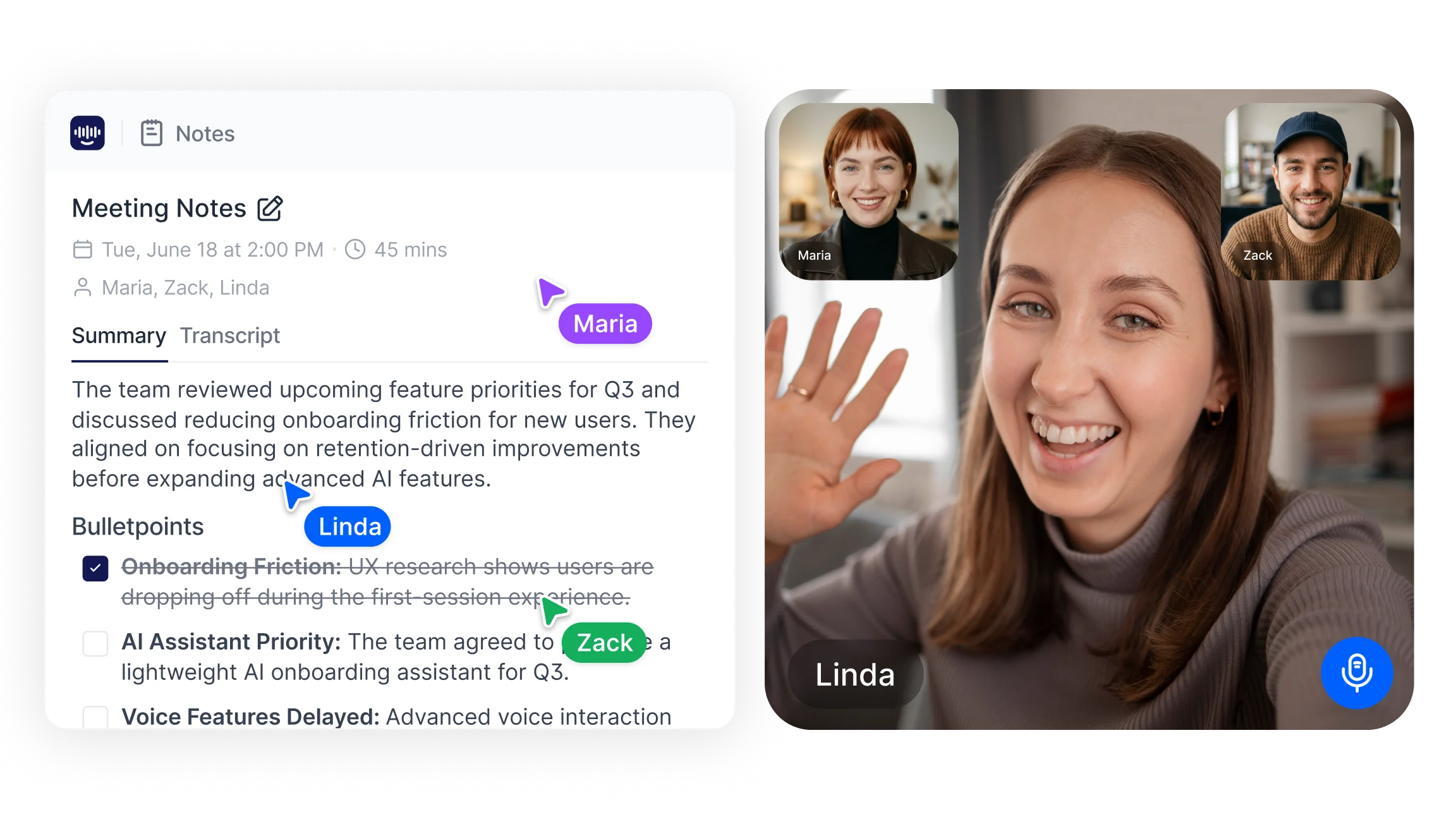
Latency determines how quickly text appears after words are spoken. Most modern systems deliver text within milliseconds to a few seconds, letting attendees read along during the conversation. Lower latency improves the live caption experience, especially during rapid exchanges, and shortens the time teams spend reconciling notes after a meeting ends.
Key Technologies Behind Real Time Speech to Text Systems
Real time transcription depends on Automatic Speech Recognition (ASR) and Natural Language Processing (NLP). ASR handles audio to text conversion, while NLP refines that output into readable sentences and extracts meaning from it.
ASR converts sound waves into text by analyzing acoustic patterns and mapping them to phonemes and words. Trained models match incoming audio to likely word sequences and produce candidate transcriptions in real time.
Speaker identification separates voices and assigns text to individual participants when possible, adding traceability and context to the transcript.
Timestamps add temporal markers throughout the transcript, allowing quick navigation to specific moments and synchronized playback during review.
Language models improve accuracy through context-aware predictions, common phrasing, and meeting-specific vocabulary, which together reduce errors and produce clearer text.
Common Features Found in Real Time Transcription Tools
Most real time transcription systems share a set of core features that improve usability and clarity.
Live captions display text on screen during meetings, helping participants follow spoken content immediately in noisy or multilingual settings.
Speaker identification labels dialogue by participant, adding accountability and context for follow up work.
Searchable transcripts let users find keywords, topics, or action items across one meeting or many, reducing review time.
Timestamps provide direct access to specific moments in a recording, making review faster and more precise.
Note generation summarizes key points and extracts action items or decisions, producing compact meeting summaries that support follow-up and task assignment.
Where Real Time Transcription Is Used in Modern Work Environments?
Real time transcription is used across remote, hybrid, and in-person meetings to keep documentation consistent regardless of location.
Virtual team meetings benefit because remote participants can follow conversations and capture decisions without relying on memory. Live speech to text helps maintain clarity for attendees joining from different environments.
Hybrid workplaces use real-time audio transcription to align in-person and remote participants, so live transcripts bridge the gap when some attendees are physically present and others join a recorded video call remotely.
Customer support conversations use real-time transcripts to record issues, capture exact phrasing, and speed up case handling. Transcripts help agents and supervisors track commitments and follow-ups.
Project collaboration sessions rely on real-time transcripts to record decisions, deadlines, and responsibilities, which keeps searchable meeting notes accurate and projects on schedule.
Training and onboarding programs use live captions and transcripts to support learners and provide accurate review material for education teams working with varied learning needs.
Benefits of Real Time Transcription for Meetings and Team Communication
Real time transcription improves meeting clarity, documentation accuracy, and accessibility.